
Why Financial Planning and Analysis Is the Foundation of Modern Business Success
Success in today’s fast-paced business world cannot be achieved without using data, insights and foresight, all of which come from a business’s ability to plan effectively. Financial planning and analysis sit at the core of this evolution; it is a strategic function that allows businesses to make well-informed decisions to help them grow.
This resource will provide information on what Financial Planning and Analysis is, why it’s more relevant than ever, its components, best practices, and how modern-day businesses can leverage FP&A for a competitive advantage.
What Is Financial Planning and Analysis ?
Financial Planning and Analysis is the finance function that is responsible for forecasting/analysing future financial performance by using all known past performance measurement tools to drive present and future profit through capital site decisions, managing corporate risk through multiple alternatives and optimizing operations for sustainable growth.

Financial Planning and Analysis serves as the nerve centre of the Finance Plan for the company, giving management teams the clarity and foresight they need to administer capital, manage risks, optimize performance and drive growth for the future.
Why Financial Planning and Analysis Is Critical for Business Success
1. Enables Data-Driven Decision Making
Financial Planning and Analysis is one of the key elements in the interpretation of Financial Information – taking Raw Financial Data and turning it into valuable Determining factors for Financial Performance. It uses budgeting, forecasting and analyzing data to provide insight for the decision maker on not just what occurred, but rather as to why, and how this will affect future decision-making. In this way, they offer an analysis from which informed and conservative decisions can be made, including but not limited to the Implementation of a strategic investment plan or resource allocation.
If the information provided by Financial advisor services to support Decision-Making is unclear, there is a significant risk that the organization will make Investment decisions based on a “Gut Feeling”, a previously outdated report or available information on a partial basis or with a lack of detail/complete information.
2. Bridges Strategy and Execution
The main role of Financial Planning and Analysis is to connect strategic and financial objectives. The purpose of Financial Planning and Analysis is to connect financial projections to business strategies. The relationship between the two will help ensure that any important strategic initiative like increasing market share, launching new products, expanding a business or reducing costs can be executed in accordance with the financial situation. Like all Financial Planning and Analysis functions, It not only analyzes the numerical data, but shows how strategy will drive financial results.
3. Drives Performance Monitoring
A competent Financial Planning and Analysis department provides an organization with ongoing monitoring of actual to planned financial performance against established Key Performance Indicators (KPIs), budgets, and forecasts. This can help an organization identify deviations early on, get to the cause, and make adjustments quickly.
The Financial Planning and Analysis department serves as a real-time guidepost to keep teams focused on achieving their financial objectives, despite the turbulence of changing circumstances.
4. Helps Manage Cash Flow and Capital Allocation
By providing businesses with insights about future cash flows, It assists organizations in making future financial decisions as well as planning for both opportunities and challenges. Whether preparing an investment round, managing working capital or addressing economic volatility, it ensures the company has the financial resources necessary to operate successfully during times of uncertainty and instability.
Core Components of Financial Planning and Analysis
Understanding the framework of Financial Planning and Analysis can help businesses structure their financial processes more effectively. Here are its essential elements:
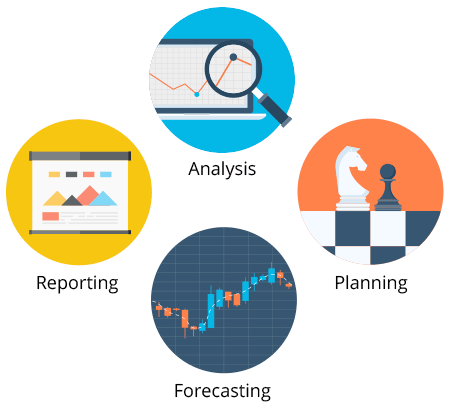
1. Planning
Financial planning lays the foundation for future success. It involves defining business goals, outlining assumptions, identifying financial goals and designing strategic paths to achieve these goals. The plan addresses questions such as:
- What revenue must we generate next year?
- How should we distribute our budgets across departments?
- What investment activities should we prioritize?
This planning phase becomes the roadmap for budgeting and forecasting processes that follow.
2. Budgeting
Creating a budget helps to translate strategic objectives into actual monetary interventions. It sets a limit on the amount of money to be spent, how to distribute financial resources, and what each department is expected to achieve financially.
A well-structured budget will give the company more control over its costs, avoid excessive expenditure and allow for assessment of performance compared to budgeted objectives.
3. Forecasting
When forecasting for future monetary impacts of a company (including sales, expenses, cash flows, etc.), you apply historical data along with predictive analyses. Unlike static budgets, forecasts are dynamic and continually updated as business conditions change.
Forecasts provide the leaders of organizations with a way to project opportunities and challenges and provide them with insight to change their strategies in real-time.
4. Scenario Planning and Modeling
How about if your earnings drop by 15% in the next zone? What happens if raw material prices increase abruptly? Organizations can model and assess potential impacts of decisions on multiple future scenarios through scenario planning.
That kind of pre-thought and pre-planning allows management to prepare for uncertainty and provides a tremendous advantage in today’s volatile markets.
5. Performance Reporting and Analysis
Reporting is the transformation of data into actionable information. Financial reporting is used to measure performance against plans/schedules/forecasting – Identify gaps in performance – Identify trends & patterns – Provide recommendations to assist with strategic decision making.
This step is where true analytics flourish and continue to transform previously complex data sets into understandable and powerful corporate narratives.
Financial Planning and Analysis vs. Traditional Accounting
Many people confuse Financial Planning and Analysis with accounting, but they serve distinct roles:
- Accounting focuses on historical accuracy: recording transactions, ensuring compliance, and producing audit-ready reports.
- Financial Planning and Analysis focuses on strategic foresight: analyzing data, forecasting future performance, guiding budgeting, and supporting leadership decisions.
While accounting ensures financial integrity, Financial Planning and Analysis ensures financial insight. Both are essential, but Financial Planning and Analysis is the engine that drives business strategy forward.
Best Practices for Modern Financial Planning and Analysis
To extract maximum value from Financial Planning and Analysis, businesses should adopt forward-looking practices that promote agility, accuracy, and alignment.
1. Invest in Data Quality
Data integrity is vital to the Financial Planning and Analysis function. Bad and/or inaccurate data could lead to INACCURATE FP&A FORECASTS AND STRATEGY. Strong data management practices, validation, and centralised data are essential to mitigating this risk.
2. Automate Repetitive Work
Traditionally, Financial Planning and Analysis teams have spent a long period of time gathering and cleaning data; now there are modern, automated solutions which can significantly reduce their own administrative work thereby allowing analysts to spend more time on providing the organization with strategic insights.
3. Embrace Advanced Analytics
It can use predictive modeling to advance from descriptive analysis to prescriptive analysis by using AI insights and scenario simulations to assist teams in addressing not simply what occurred or will happen, but also suggesting possible actions moving forward.
4. Promote Cross-Functional Collaboration
It is embedded in: Sales, Operations, Human Resources and Marketing. Collaborative efforts with other departments provide valid forecasts reflecting both operational functions and strategic priorities, ultimately helping the organization develop a cohesive strategy across all areas of the business.
5. Regularly Re-Evaluate Goals
The rapidly changing business environment is affected by many factors including economic changes, supply chain disruptions and the changing expectations of customers. A continuous forecast model provides organizations with a proactive approach through the use of periodic strategic reviews.
Real-World Impact: How FP&A Powers Growth
Companies that excel at Financial Planning and Analysis often outperform peers in revenue growth, margin expansion, and operational efficiency. They drives competitive advantage by:
- Empowering leadership with actionable insights.
- Helping allocate capital wisely and prioritize strategic investments.
- Identifying risks early and enabling proactive mitigation.
- Tracking performance rigorously and refining strategies based on results.
- Connecting financial outcomes to broader business objectives.
These capabilities transform the finance function from a passive reporting department into a strategic growth partner.
How Analyticasa Helps You Master Financial Planning and Analysis
Financial Planning and Analysis, Strategic Finance and Process Improvement are the areas where we thrive at Analyticasa, providing you with the highest level of financial planning services possible and ensuring you are able to run your business effectively with well-managed finances.
- Expert Financial Planning & Analysis Services : We deliver actionable insights to leadership teams to support growth and strategic decision-making.
- Strategic Finance Consulting : Tailored strategies that align financial goals with long-term business visions.
- Process Improvement & Optimization : Streamlining workflows and reducing operational cost to drive efficiency.
- Data-Driven Decision Support : Enabling leadership teams to base decisions on robust, accurate analytics.
By leveraging modern analytical methodologies and proven industry processes, we convert the typical role of finance (functional necessity) into one that is essential to your company’s overall success (strategic advantage to the business).
Conclusion
Financial Planning and Analysis is crucial to succeed financially, especially in today’s ever-changing environment. Utilizing it will provide companies not only with the tools, but also with the framework they need to address uncertainty, improve performance and develop long-term growth strategies.
Combining planning, forecasting, modeling and performance analysis through a data-driven approach allows an organization to take the uncertainty out of finance and provide clarity to their numerical data, providing insightful information to help develop successful business strategies and create real value.
Partnering with a Financial Planning and Analysis provider is critical for long-term organizational success by ensuring that they will continue providing actionable and opportunity-rich solutions for their organization.


Need to raise your site's score?
We have an ideal solution for your business marketing